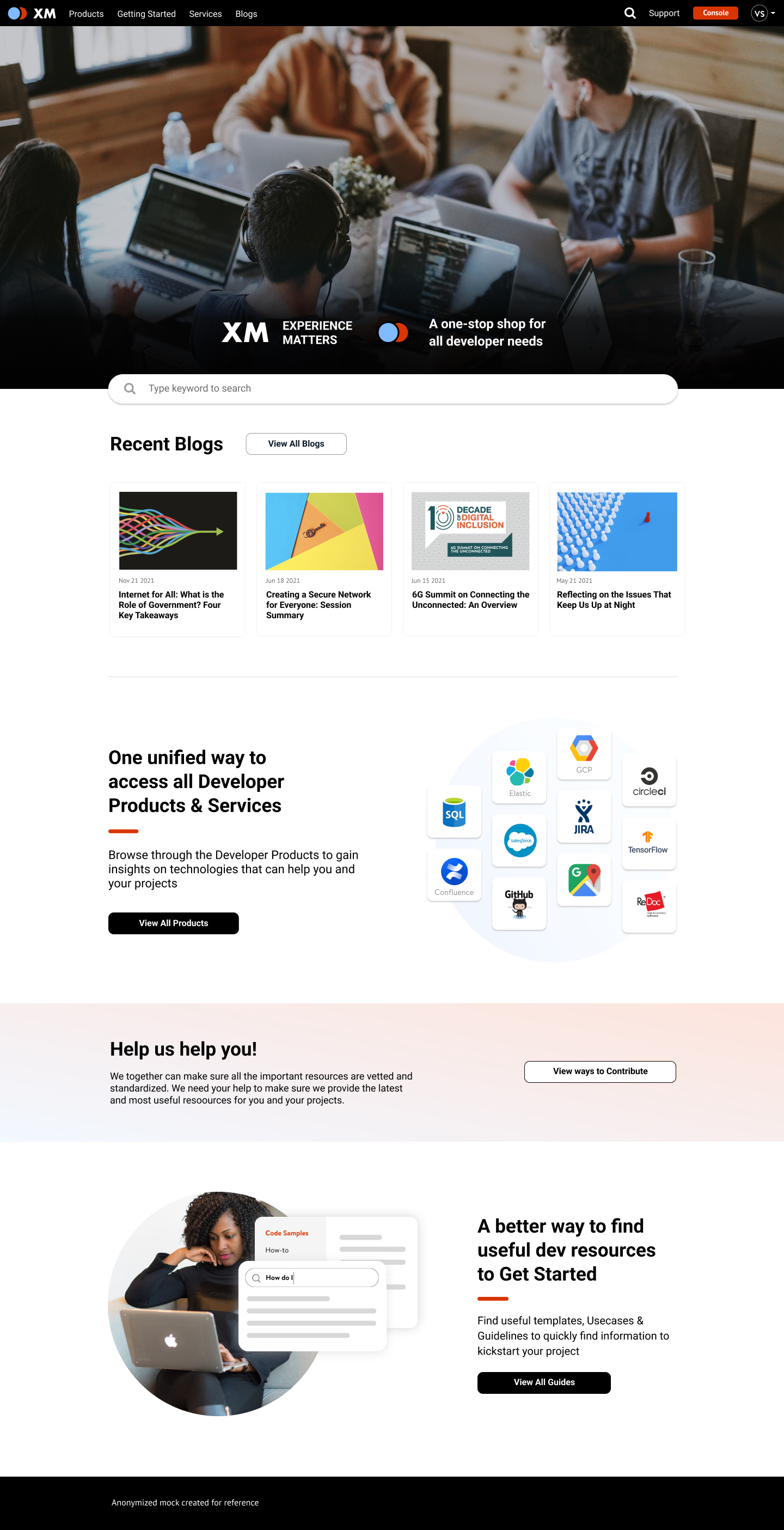
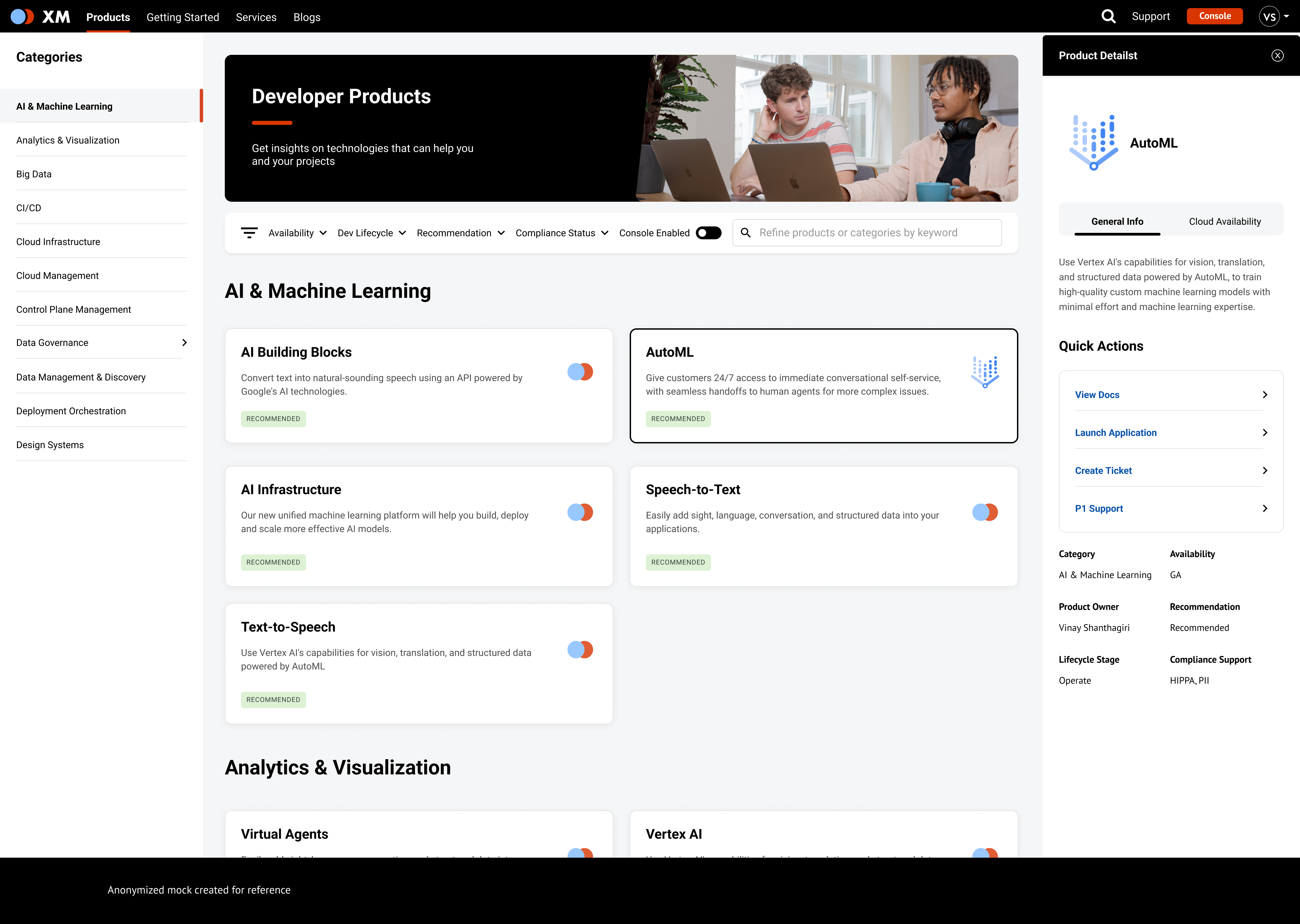
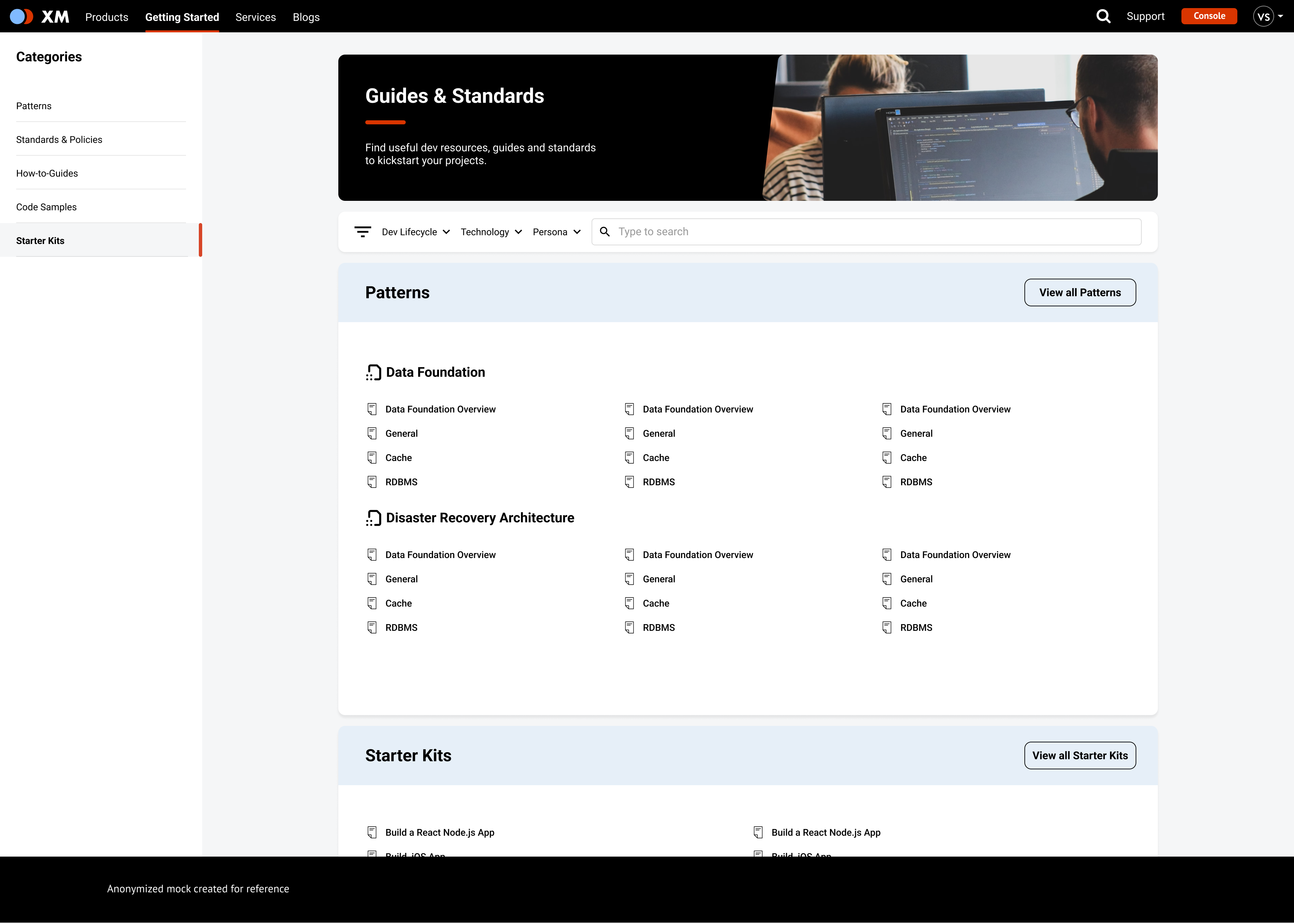
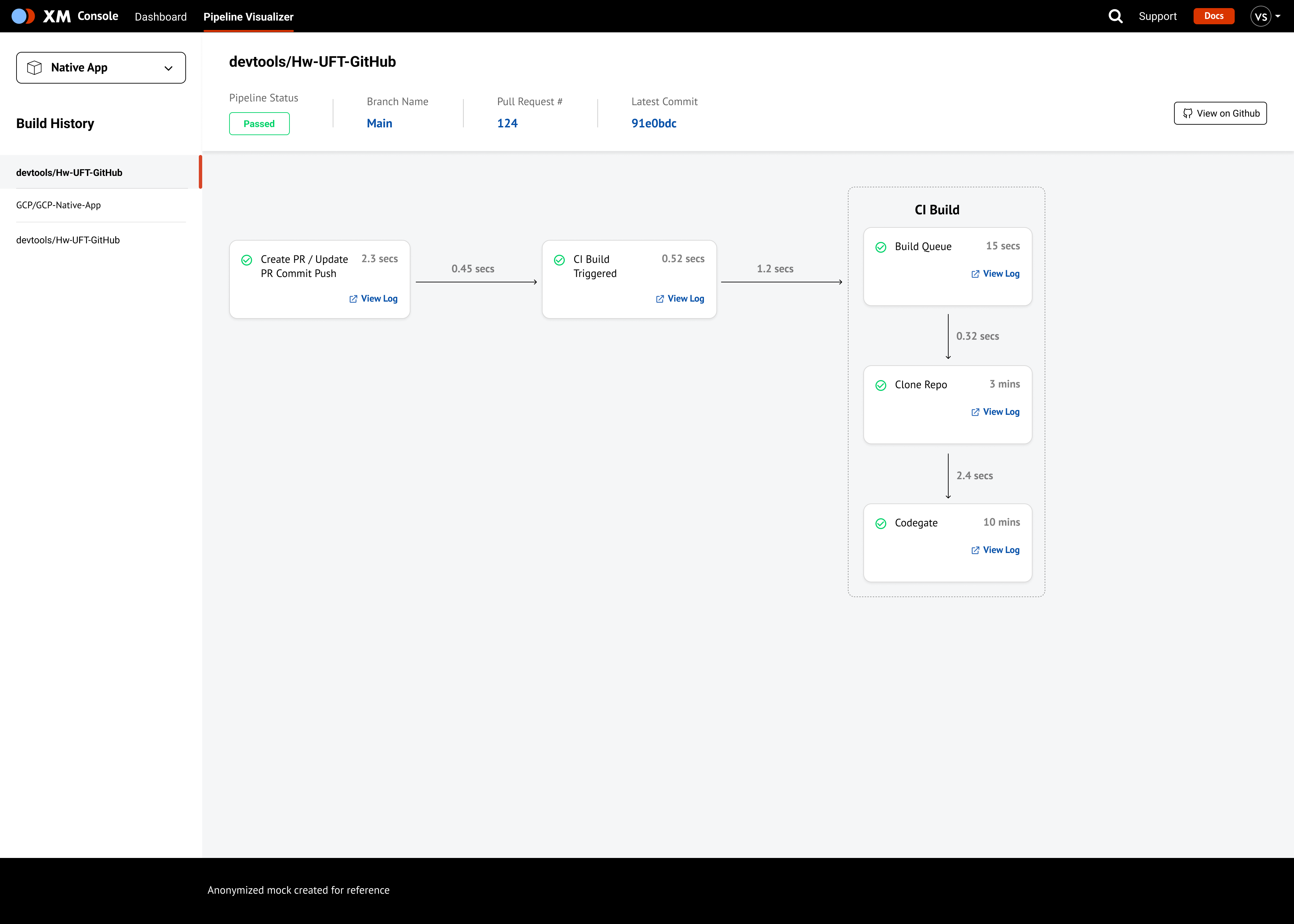
190+ developer products, 800+ documents, 23 scattered sites — unified into one portal for 17,000+ developers.
Role
Lead UX Consultant (Slalom)
Scope
Discovery · IA · Personas · Journey map · UX system · Implementation
Audience
17,000+ engineers, contributors, and moderators
Outcome
Unified developer portal across the enterprise
Developer Experience portal and product surfaces.
Overview
An established tech company had grown its developer surface area into 23 scattered sites, 800+ standards documents, and 190+ developer products. Engineers couldn't reliably find which document was canonical, which version of a pattern to follow, or whether an internal product was even available for their project. I led the design effort to unify it into a single trusted portal for 17,000+ developers.
The problem
The pain wasn't lack of content — it was lack of signal. Engineers wasted hours hunting for the right version of a guideline. New hires took too long to ramp up. Department leads kept fielding the same "is this still the standard?" questions. Tooling and process were siloed across the development lifecycle, and integration / automation lived only in tribal knowledge.
"By the time I find a guideline and start implementing it, someone sends me a new version. I just want one place that's standardized so I don't have to do more work to find something."
Approach
The work moved from listening to leadership and developers, to mapping how each role actually uses the platform, to building a unified IA and the components to support it.
Discovery interviews. Stakeholder conversations with leadership ("we need one platform that's the source of truth"), department leads (drowning in repeated questions about standards), and engineers (frustrated by stale guidelines and scattered tooling).
Three core personas. Surfaced Consumer (engineer reading docs and shipping), Contributor (engineer publishing patterns and updates), and Moderator (department lead approving and standardizing). Each had a distinct loop and distinct success metrics.
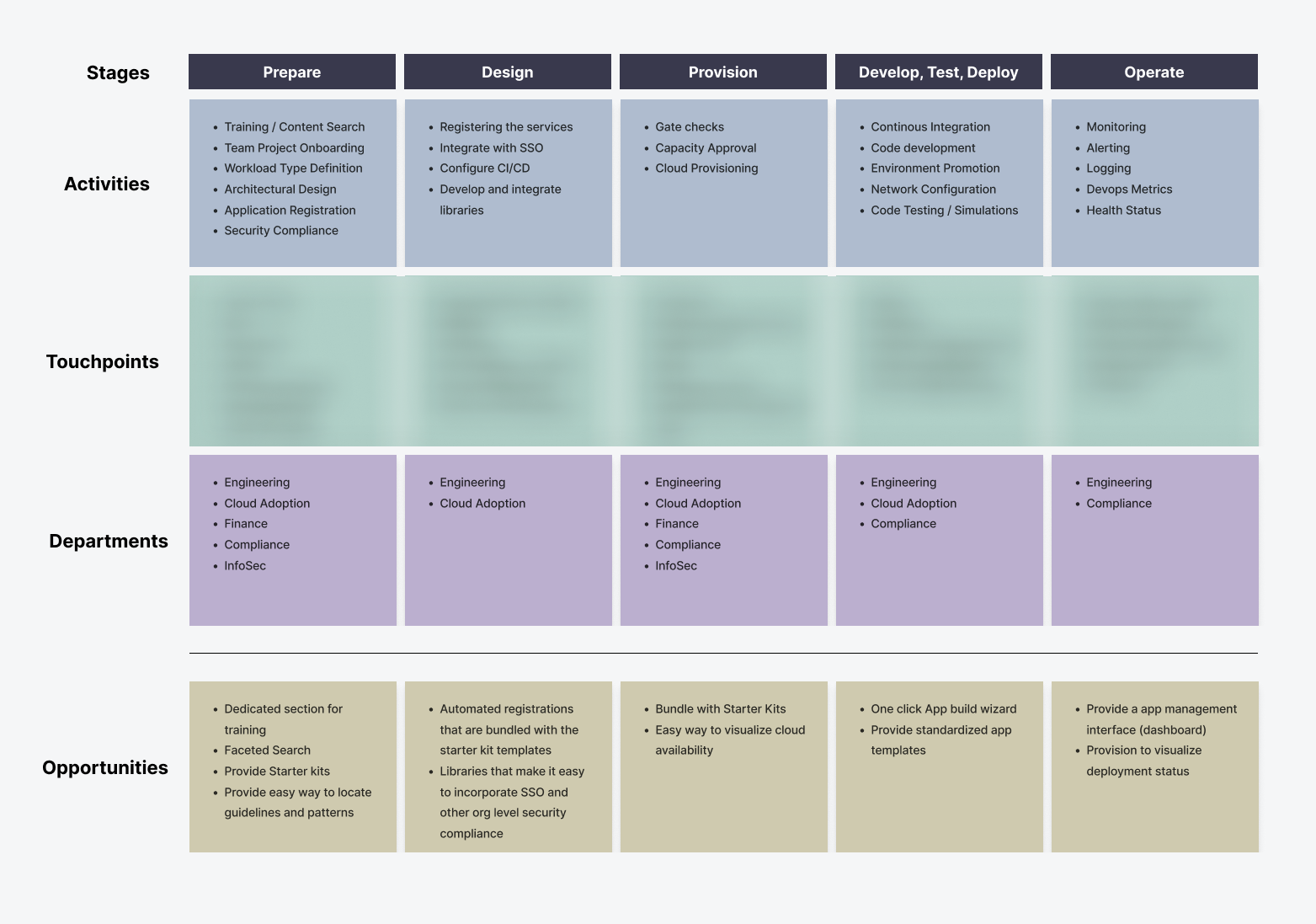
Journey map. Mapped the end-to-end flow — onboarding, pattern discovery, implementation, contribution, review — and identified the breakage points where time and trust leaked.
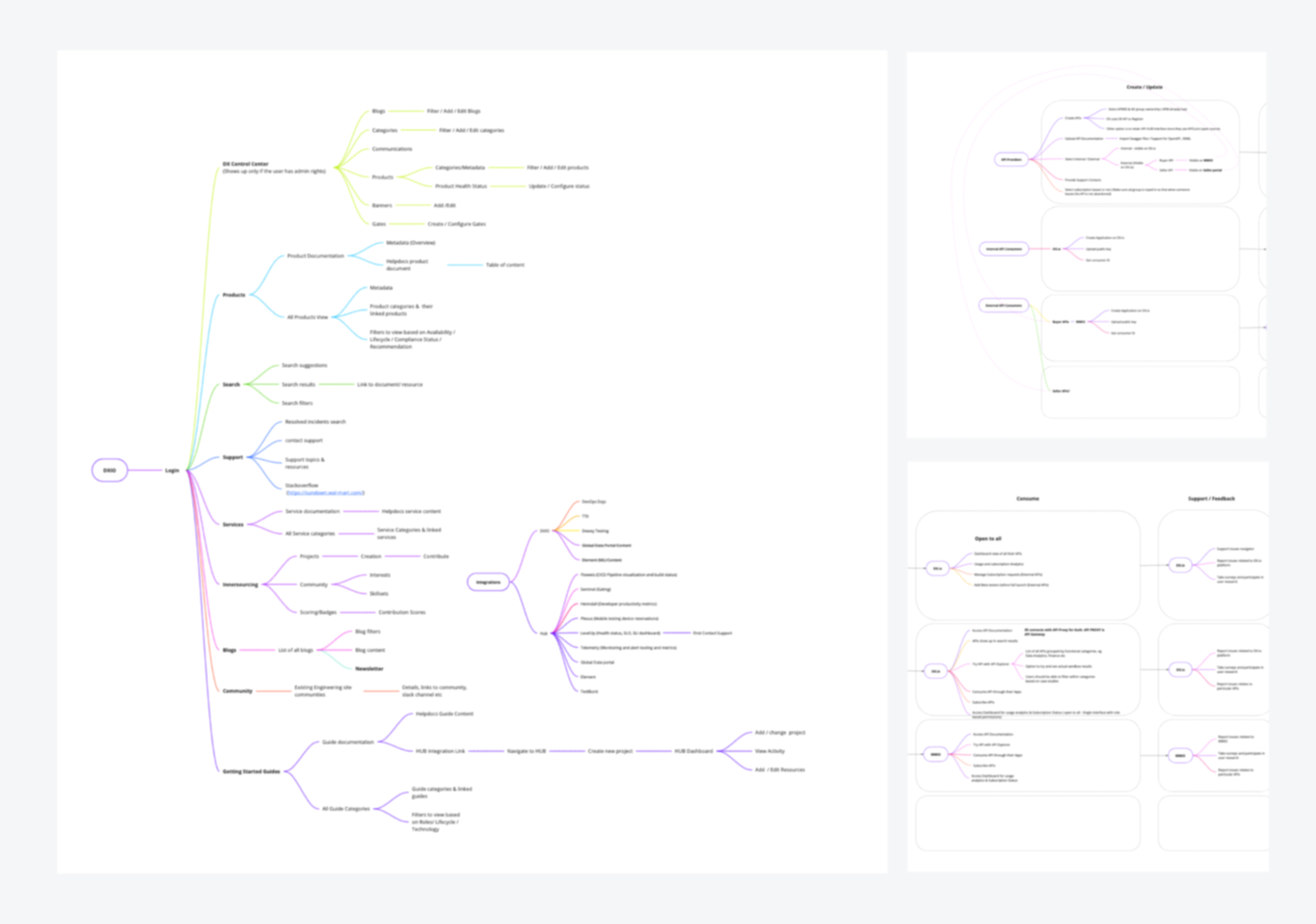
Information architecture. Designed a content model that handled versioning, ownership, freshness signals, and cross-product relationships — so a single page could carry the metadata each persona needed.
Iterative high-fidelity. Brainstormed user flows, ran content assessments against the existing 800+ documents, and iterated through low-fidelity into a polished portal experience grounded in the company's design system.
Mapping the consumer / contributor / moderator journeys end-to-end.
User flows aligned to the new IA — versioning, ownership, and freshness baked into the model.
Outcome
The 23 sites collapsed into one trusted portal. Engineers could find the canonical version of a guideline without pinging Slack. Contributors could publish without manually announcing every update. Moderators could enforce standards through the platform instead of through repeated meetings. New-hire ramp-up time dropped, and the IA gave the company room to add new developer products without re-fragmenting the experience.
Reflections
Findability is a content problem. No amount of nav tweaks fixes a portal where ownership, versioning, and freshness aren't first-class. The IA had to make those visible.
One portal, three loops. Consumer, contributor, and moderator each have different success metrics. Designing for the union — not the average — kept the platform honest.
Standards spread through software, not memos. Once moderation lived in the platform, the "is this still the standard?" question stopped surfacing in chat.
Want a deeper walkthrough of the IA, content model, or journey maps?
I'm happy to share the artifacts and the discovery research that drove them.