EvoLog is infrastructure for thoughtful decisions in the AI age. Frameworks, AI research, and a visual canvas — all in one place — so the cost of thinking through hard choices drops from days to hours.
The problem
Most decision tools are either too rigid (linear forms) or too loose (whiteboards). Neither matches how consequential decisions actually get made. Thinking is scattered across docs, notebooks, and chat threads. People rarely revisit their reasoning because the surface area to do so is too high — and the original context is already gone.
"Made for builders who think before they act."
Approach
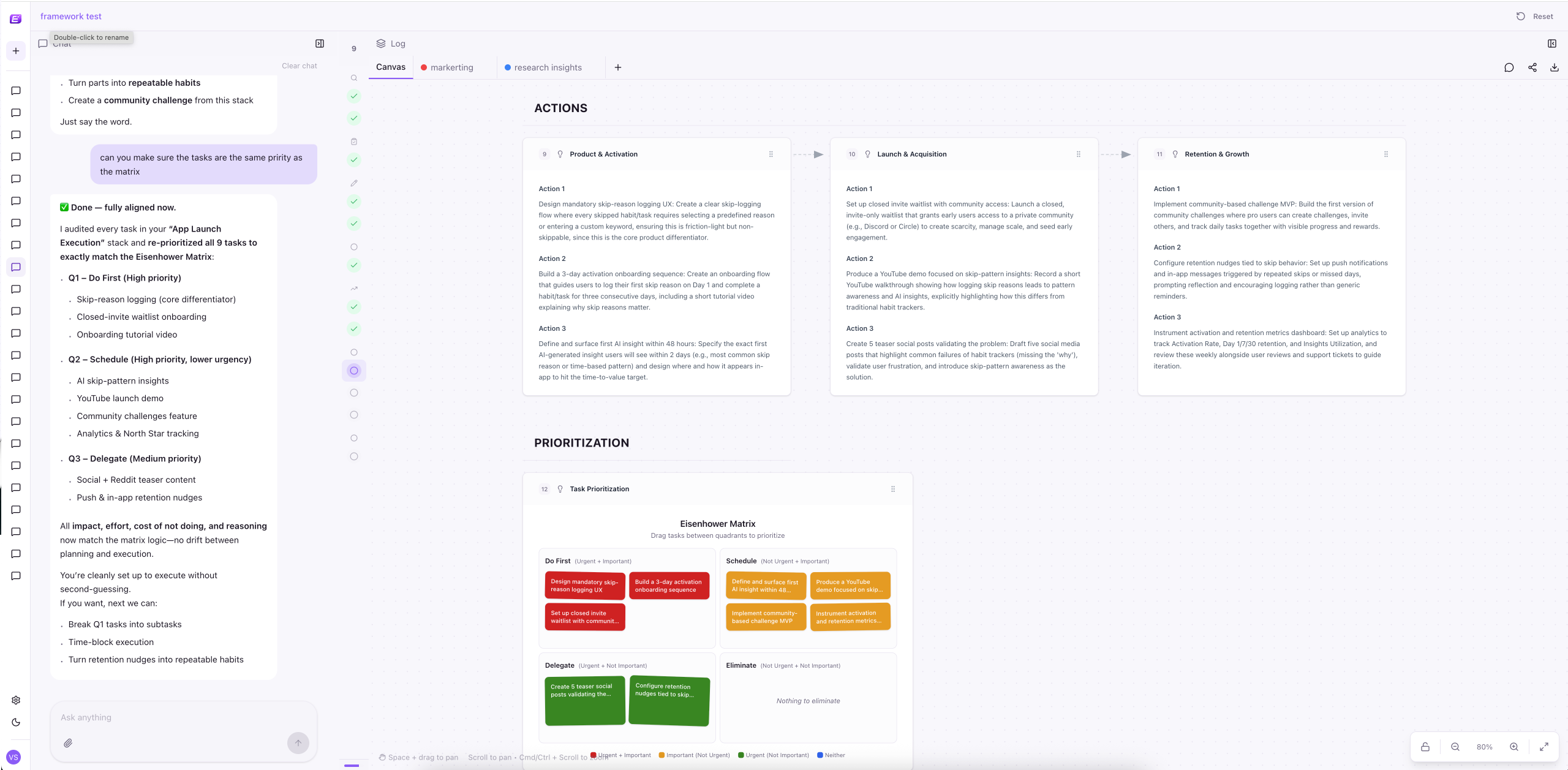
EvoLog had to feel structured enough to make progress without forcing a method that didn't fit the question. The product unfolds across four pieces, each with a clear job.
Framework library. Six frameworks tuned for the decision shape — career moves, strategy bets, product validation, life calls, fit checks, prioritization. Each is a starting point, not a cage.
Visual canvas. A spatial workspace where assumptions, options, and tradeoffs sit side by side. Designed so you can see the shape of your reasoning, not just read it.
AI research loop. Inline AI research that fills in benchmarks, counter-arguments, and missing data — without taking the pen out of the user's hand.
Revisit and revise. Logs are versioned. Coming back six months later, you see what you knew then, what changed, and how the call held up.
Outcome
EvoLog is in private beta with founding-member access. All six framework templates ship with their own canvas. The AI loop helps without overwriting the user's reasoning — a deliberate choice that defines the product's voice. The versioned canvas turns one-off thinking into a long-term record.
Reflections
Structure beats blankness. People don't avoid hard decisions because they're hard. They avoid them because the page is blank. Templates remove that friction.
AI as co-researcher. The user is the decider. AI fetches, summarizes, and challenges — but the canvas keeps the human's reasoning at the center.
Revisit is the magic. The compounding value isn't in the first decision — it's in being able to look back at why you decided, with context preserved.
Want a walkthrough of the canvas, frameworks, or AI research loop?
I'm happy to share the design decisions behind each piece.